AI Assistants Are Choosing Chiropractors For Your Patients
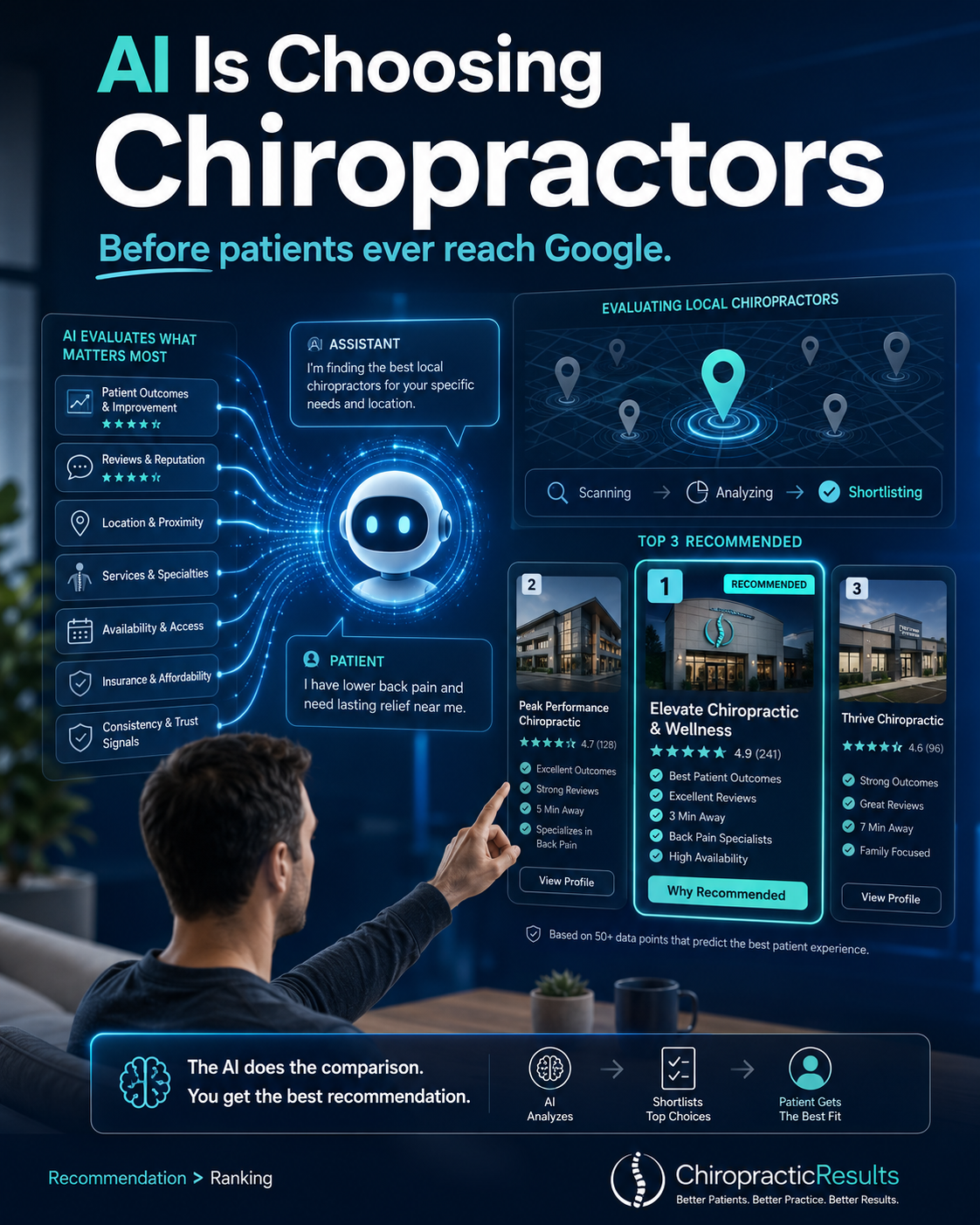
AI Is Choosing Chiropractors Before Patients Ever Reach Google
For years, chiropractic marketing was built around one basic assumption:
The patient searches. The patient sees a list. The patient compares their options. The patient chooses.
That process is changing fast.
Today, a patient can ask ChatGPT, Google AI Mode, Gemini, Perplexity, Claude, or another AI assistant something like:
“Who is the best chiropractor near me for sciatica?”
And instead of giving them 10 blue links and making them do the research themselves, the AI may do the comparison for them.
It searches.
It evaluates.
It compares.
And then it recommends a handful of businesses.
Search Engine Journal recently described this shift simply:
AI assistants are increasingly doing the comparison work that customers previously did themselves.
That distinction matters enormously for chiropractors.
Because the new question is no longer simply:
“Where do I rank?”
It is:
“Does AI consider my clinic worthy of recommending at all?”
The New Local Search Funnel
Traditional local SEO looked something like this:
Search → Rankings → Website → Patient Decision
AI search increasingly looks like:
Patient Question → AI Research → AI Shortlist → Patient Decision
That means an enormous portion of the decision-making process can happen before the patient ever visits your website.
The patient may never see your homepage.
They may never read your About page.
They may never scroll through ten Google results.
They may simply ask:
- Who is the best chiropractor for migraines near me?
- What chiropractor is good with kids?
- Who treats herniated discs?
- Which chiropractor has the best patient outcomes?
- Who would you recommend for sciatica?
- Is there a chiropractor near me who specializes in neuropathy?
And increasingly, AI is answering the question.
Search Engine Journal notes that some local AI recommendation queries may narrow the field to only a few businesses.
That is a radically different game.
You aren't fighting for position #7 instead of position #9 anymore.
You may be fighting to make a shortlist of three to five businesses.
Getting Indexed Isn't Enough
One of the most important ideas from Google's own guidance is that AI answers are still heavily dependent on information that can be retrieved from the web.
Google describes its AI systems as using techniques including retrieval-augmented generation, sometimes called grounding, to find supporting information before generating an answer.
It can also use query fan-out, where the system effectively runs multiple related searches around the original question.
So a patient asking:
“Best chiropractor for pregnancy-related back pain in Indianapolis”
may trigger research around:
- pregnancy chiropractic
- prenatal chiropractors
- back pain treatment
- Indianapolis chiropractors
- patient reviews
- clinic reputation
- services
- outcomes
- other third-party references
The AI isn't necessarily looking for one perfect page.
It is building an understanding of the clinic from multiple pieces of evidence.
And that leads to one of the biggest concepts chiropractors need to understand about AI visibility:
Your website is only one witness.
Google may see your website.
But it may also see:
- your Google Business Profile
- patient reviews
- directory listings
- articles mentioning you
- local citations
- professional profiles
- comparison pages
- social proof
- third-party databases
- structured information about your doctors and clinic
Search Engine Journal specifically notes that AI answers can pull information from sources a business doesn't control—including directories, articles, and comparison pages.
That makes third-party authority increasingly important.
This Is Why Patient Results Matter
Most chiropractic marketing tells AI what the chiropractor does.
Very little tells AI what the chiropractor has actually helped people with.
There is a major difference between:
“We offer chiropractic care for back pain.”
and having a documented ecosystem showing:
- patients with back pain
- patients with sciatica
- patients with headaches
- patients with neck pain
- patients with herniated discs
- patients with pregnancy discomfort
- patients with neuropathy
- patients reporting measurable improvement
That is one of the ideas behind ChiropracticResults.
We are building a structured, third-party layer of documented patient results that helps search engines, AI assistants, and ultimately patients better understand:
WHO you help. WHAT conditions you help. WHERE you help them. And WHAT patients actually report experiencing.
Your website makes a claim.
Patient outcomes create evidence.
Third-party patient outcomes create corroboration.
And in a world where AI systems are gathering information from multiple sources before recommending businesses, corroboration becomes incredibly valuable.
Reviews Are Becoming Machine-Readable Reputation
Reviews have always mattered.
But historically, chiropractors thought about reviews primarily as a conversion tool.
Someone finds your Google profile.
They see 427 five-star reviews.
They feel comfortable booking.
That still matters.
But reviews are increasingly becoming something else:
training data for the decision.
AI can extract meaning from review language.
If dozens of patients repeatedly talk about:
- sciatica improvement
- headaches
- pregnancy
- pediatric care
- sports injuries
- disc problems
- neuropathy
that gives machines significantly more context about what your clinic may actually be known for.
Search Engine Journal specifically points to listings, reviews, and reputation as signals that can affect whether a business is considered in AI-generated responses.
The chiropractor with the most stars may not automatically win.
The chiropractor with the strongest body of relevant evidence may become much easier for AI to understand and recommend.
Consistency Is Now an AI Problem
There's another overlooked issue.
AI systems may encounter conflicting information about your business.
Your website says one thing.
Google Business Profile says another.
An old directory says something else.
An article from three years ago has outdated information.
Google does not publicly explain exactly how its AI systems resolve every conflicting source.
That means chiropractors should assume that information consistency matters more than ever.
Your clinic should have consistent information about:
- doctors
- locations
- services
- conditions
- hours
- phone numbers
- booking links
- specialties
- credentials
- outcomes
across the broader web.
You are essentially helping AI build a cleaner entity understanding of your clinic.
Google Search Console Still Can't Tell You the Whole Story
This may be the most dangerous part for clinic owners.
Traditional analytics can make it look like nothing has changed.
Google is beginning to provide more reporting around generative AI appearances, but the reporting still has major blind spots.
According to the article, Google's generative AI reporting can show impressions by page, country, device, and date—but it does not tell businesses the query that caused the appearance or whether the business itself was actually recommended.
And it tells you nothing about what ChatGPT, Claude, Perplexity, or other assistants said.
So the owner asks:
“How much traffic did ChatGPT send me?”
But that may be the wrong metric.
A patient could ask ChatGPT:
“Who's the best chiropractor for sciatica near me?”
ChatGPT recommends you.
The patient remembers your name.
Then searches your clinic directly on Google.
Google Analytics credits Google.
ChatGPT influenced the decision.
And your analytics may never show it.
This is why ChiropracticResults has increasingly focused on AI visibility, not merely AI referral traffic.
We want to know:
Are you being mentioned?
Are you being recommended?
For which conditions?
Against which competitors?
Across which AI assistants?
Those are completely different questions from:
“How many clicks did I get?”
The Website Isn't Dead. Its Job Is Changing.
Your website still matters.
Google explicitly recommends making important information available as crawlable text, maintaining accurate business information, keeping crawling permissions open, and using structured data that accurately matches what's visible on the page.
But the role of the website is evolving.
It used to primarily convince humans.
Now it also needs to help machines understand your clinic.
Your site should make it extremely obvious:
- who you are
- where you practice
- what conditions you help
- what services you offer
- what makes you different
- what evidence supports your claims
- how someone becomes a patient
Don't make AI guess.
And Then Comes the Next Shift: AI Agents
Recommendation is only phase one.
The next phase is action.
Google is already discussing AI agents capable of completing tasks for users, including interacting directly with websites.
That means the future chiropractic patient journey could eventually look like:
“Find me a highly rated chiropractor nearby who has experience with herniated discs and can see me this week.”
The AI:
- researches clinics
- compares them
- selects one
- checks availability
- schedules the appointment
At that point, the chiropractor isn't optimizing for a click.
They're optimizing for an AI decision.
That is why everything happening right now around AI visibility matters so much.
The ChiropracticResults Thesis
We believe local healthcare discovery is moving from:
Search Engine Optimization
to:
Recommendation Engine Optimization.
The winners won't simply be the clinics with the prettiest websites or biggest advertising budgets.
They will be the clinics that machines can clearly understand, verify, and confidently recommend.
That requires building a web of evidence around your clinic:
Patient outcomes. Reviews. Reputation. Structured data. Third-party authority. Consistent clinic information. Condition-specific proof. AI-readable content.
Because the internet is moving from:
“Here are ten chiropractors.”
to:
“Here are the three chiropractors I recommend.”
And eventually:
“I found the chiropractor I think is best for you. Would you like me to book the appointment?”
That's the game ChiropracticResults is being built for.
Not simply helping chiropractors rank.
Helping chiropractors become recommendable.
Want to Know Whether AI Recommends Your Clinic?
ChiropracticResults' AI Visibility Report tests your clinic across major AI assistants and hundreds of local patient-intent prompts to uncover:
- where your clinic appears
- where competitors beat you
- which conditions you have authority around
- where your AI visibility is weak
- what needs to change next
Because your future patient may never search through ten chiropractors.
Their AI might choose for them.
The question is whether it chooses you.