Does Upper Cervical Chiropractic Have a Distribution Problem… or a Value Problem?
THE MOAT WAS NEVER THE MACHINE.
I saw an interesting conversation yesterday about the future of Upper Cervical.
The problem being discussed is legitimate:
Almost nobody gets Upper Cervical care.
So how do you reach more people?
Train more students. Make seminars cheaper. Get into more schools. Market harder.
Apparently another idea being discussed is expanding the technology into the medical profession.
And if that's actually the direction we're headed, I have a question:
What exactly are we selling?
Because here's how that idea lands to me:
"We haven't been able to get enough chiropractors to adopt this… so maybe MDs will."
And I'm not even saying that as an insult.
It might actually be a brilliant distribution strategy.
But it creates a much bigger identity problem for Upper Cervical.
People don't drive three hours, get on airplanes or hunt down a NUCCA, Blair, AO or Upper Cervical doctor because they're desperately searching for a machine that can push on C1.
They go because they believe they've found a specialist.
Someone who has studied something most doctors haven't.
Someone who sees the cervical spine differently.
Someone who has spent years learning when to adjust, when not to adjust, how to analyze the patient, how to interpret the films, how to measure change and how to manage the case afterward.
That scarcity is part of the value.
Now imagine the message becomes:
Good news. Your medical office can buy the technology too.
That could absolutely expose Upper Cervical concepts to millions more people.
But it may also accidentally tell the market:
The magic wasn't the Upper Cervical doctor. The magic was the equipment.
And THAT is where I think chiropractors should pay attention.
Because we've seen this movie before.
If what makes you special can be reduced to a protocol + software + machine…
Eventually somebody with more distribution gets the protocol + software + machine.
Medicine has more distribution.
Hospitals have more distribution.
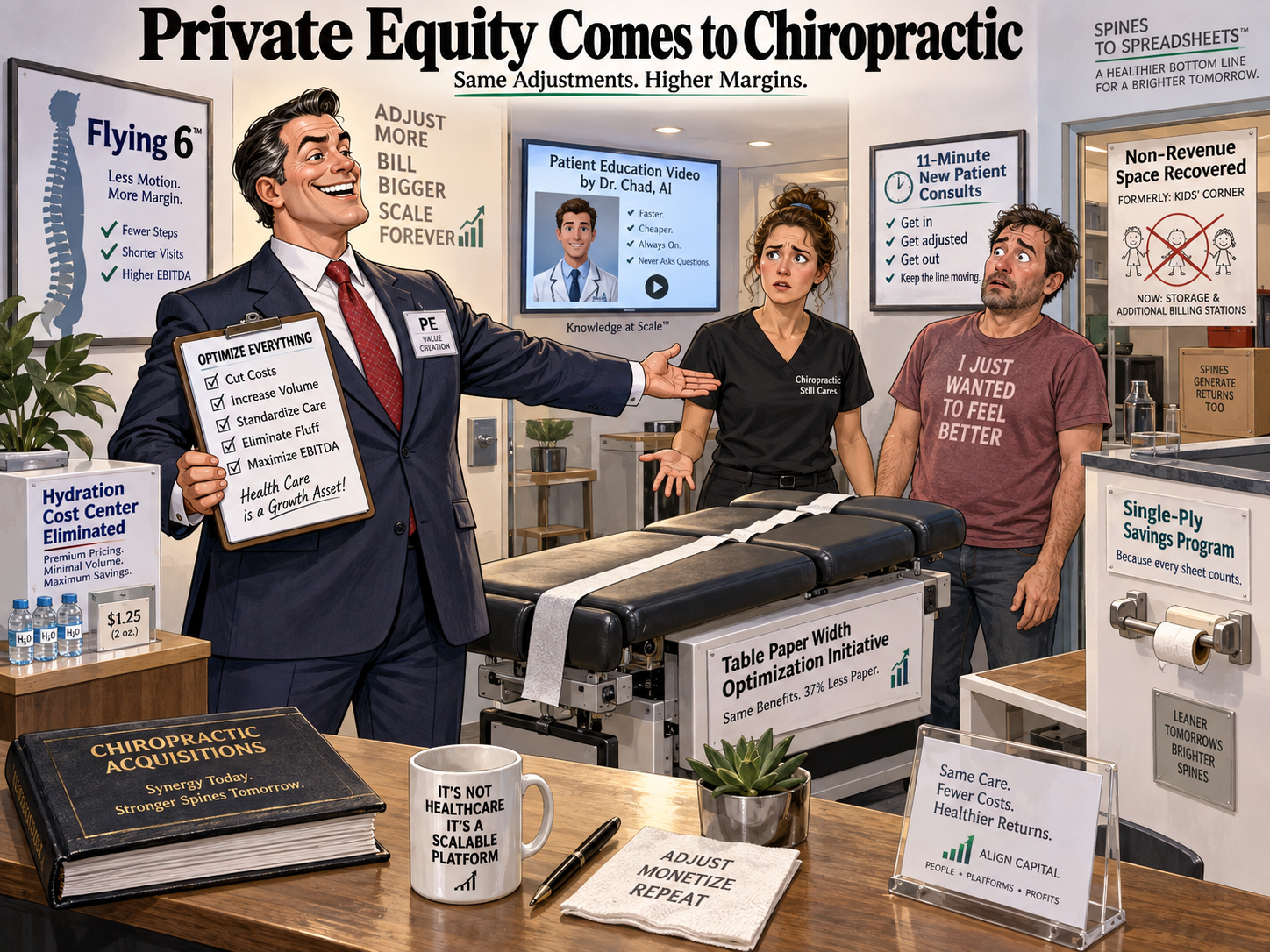
Private equity has more distribution.
Large healthcare systems have more distribution.
Chiropractic's advantage has never been that we possess equipment nobody else can buy.
Our advantage is supposed to be the thinking behind the care.
The expertise.
The philosophy.
The clinical judgment.
The obsession with something other providers barely look at.
EPIC itself currently markets its approach as an Upper Cervical chiropractic technique built around imaging, analysis, digital calibration and percussion technology.
So maybe expanding outside chiropractic grows the pie.
Maybe it creates collaboration.
Maybe thousands of patients eventually discover Upper Cervical who otherwise never would.
I'm completely open to that argument.
But I also think the Upper Cervical world needs to wrestle with the other side:
If a medical doctor can buy the technology, take the training and deliver what the public perceives to be the same thing… why should someone fly across the country to see you?
That's not a reason to protect the machine.
It's a reason to build a bigger moat.
Better outcomes.
Better evidence.
Better case documentation.
Better patient education.
Better specialization.
Better storytelling around what an actual Upper Cervical expert knows that a weekend-trained provider doesn't.
Because maybe the problem isn't that 99% of America hasn't experienced Upper Cervical.
Maybe the problem is that Upper Cervical still hasn't done a good enough job explaining to 99% of America why they should care who delivers it.
And if we don't answer that question…
Someone else eventually will.
The future of Upper Cervical can't just be protecting who owns the tool.
It has to be proving the value of the person using it.