Is Private Equity Going to Destroy Chiropractic — or Is Saudi Money Our Only Hope?
I was watching a podcast this morning and they started talking about private equity ruining sports and fast food.
And I immediately thought:
Oh shit. Chiropractic.
Their example was basically this:
Wendy’s doesn’t suddenly become terrible.
It happens one stupid little decision at a time.
Somebody realizes fresh lettuce costs more than bagged shredded lettuce.
Nobody dies.
The spreadsheet gets slightly better.
The sandwich gets slightly shittier.
Repeat that decision 100 times.
Eventually you’re standing there holding something with the same logo, the same name and technically the same ingredients...
…but it ain’t the same fucking sandwich.
And I wonder if chiropractic is heading toward its shredded-lettuce era.
Because money is coming.
More groups.
More consolidation.
More MSOs.
More sophisticated operators.
More people realizing that 70,000-ish chiropractors running thousands of fragmented little businesses looks awfully interesting if you know how to aggregate businesses.
This isn’t entirely theoretical, either.
The Vistria Group acquired Medulla, the organization behind Chiro One, back in 2017, and Medulla today operates a large centralized chiropractic management organization supporting Chiro One and MyoCore.
And The Joint—public company, not private equity—is making its own version of the financialization move. In 2026 it continued selling company-operated clinics and moving toward an almost completely asset-light franchise model.
So this conversation is coming.
And here's the part that makes me laugh.
Private equity probably won't walk into chiropractic and immediately announce:
“Patients no longer matter.”
Of course not.
It’ll be much dumber than that.
It’ll be:
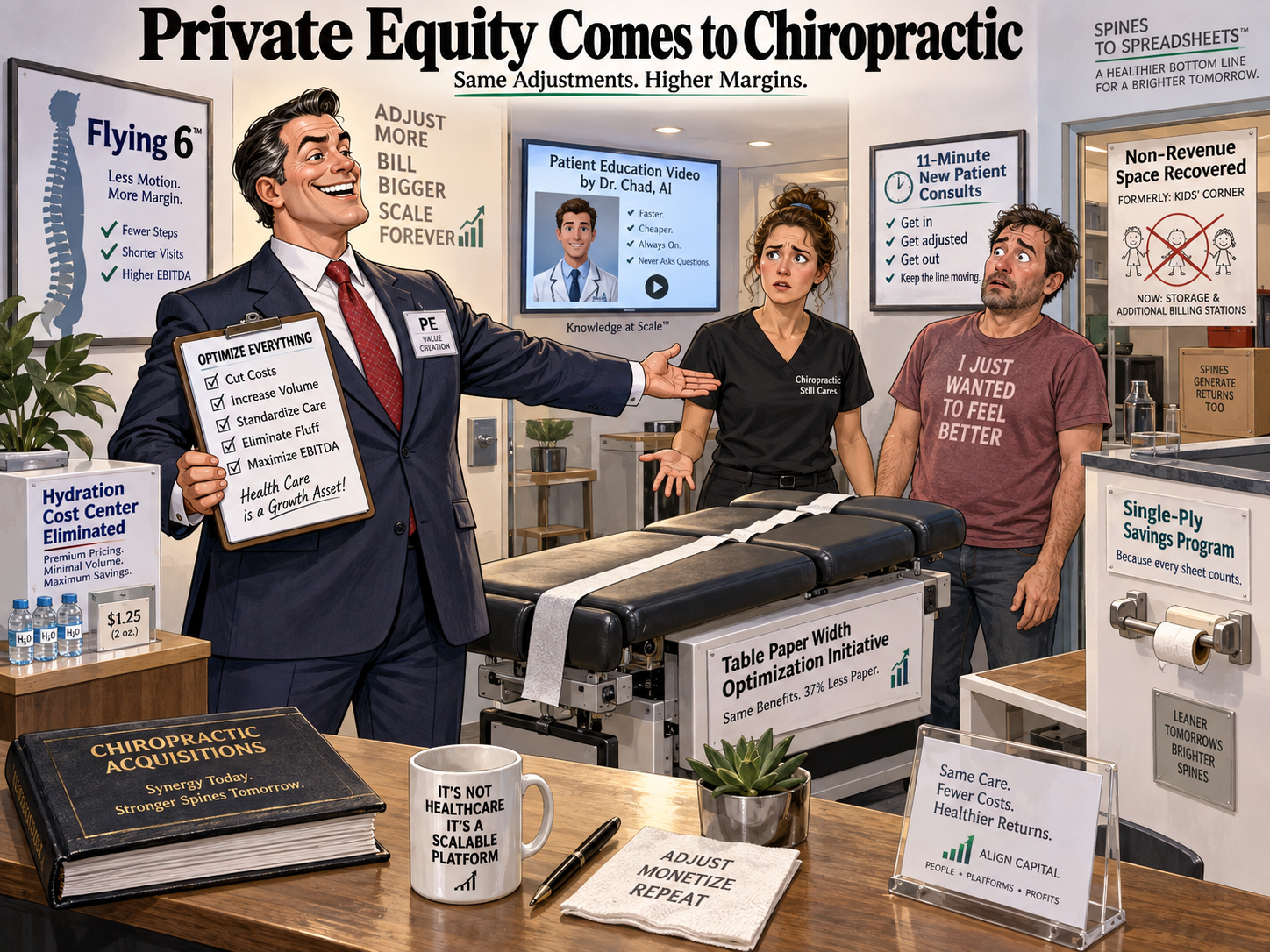
- Table paper is now 3 inches narrower. Corporate has determined butt-cheek exposure does not materially impact patient retention.
- No more Flying 7. We're doing the Flying 6. That's a 14.2% reduction in provider movement. Huge EBITDA opportunity.
- The kids' corner is gone. Legos are occupying 34 square feet of non-revenue-generating real estate.
- New-patient consultations are now 11 minutes. Minute 12 requires regional-manager approval.
- Your doctor spent six extra minutes talking to a scared new patient. Congratulations. He has now triggered a red “VISIT DURATION VARIANCE” notification.
- Free bottled water is discontinued. Apparently hydration has negative unit economics.
- Patient education is now a seven-minute corporate video narrated by an AI avatar named Dr. Chad.
- That weird front-desk lady who's been there 17 years and knows every patient's kids by name? Unfortunately her salary-to-direct-revenue ratio doesn't benchmark well.
- The office Christmas party is now a $13.42 DoorDash credit. Culture remains one of our core values.
- Your clinic dog has been eliminated. Non-performing asset.
- Doctors will no longer have individual adjusting styles. Please select Technique Package A, B or C from the corporate clinical playbook.
- And yes, we're going to single-ply toilet paper. Every basis point matters, motherfucker.
And that's funny.
Until you realize that's actually how great things get destroyed.
Not usually through one catastrophic decision.
Through a thousand completely defensible optimizations.
But here's where I disagree with the automatic “PRIVATE EQUITY BAD” take.
There is a shitload about chiropractic that probably needs professionalization.
Billing?
Please professionalize it.
HR?
Dear God, yes.
Compliance?
Yes.
Technology?
Yes.
Purchasing power?
Absolutely.
Recruiting?
Yep.
Better training?
Please.
Better data?
Hell yes.
Outcomes tracking?
Inject it into my veins.
And imagine being a 62-year-old chiropractor who's built an incredible practice for 35 years.
His kids don't want it.
His associate can't afford it.
He has $2 million of his net worth trapped inside a business that basically owns him.
Somebody shows up, pays him real money, keeps the clinic open, gives the younger doctors benefits, centralizes the bullshit and allows the founder to finally leave on Wednesday afternoon without somebody calling him because the printer isn't working.
That's not evil.
That's fucking awesome.
There are legitimate reasons doctors sell.
There are legitimate reasons capital can make healthcare organizations better.
The GAO's 2025 review of healthcare consolidation even documented examples where private-equity-backed organizations gave practices better administrative infrastructure, scheduling and resources that helped expand access. The larger evidence base, however, is still mixed and incomplete.
So I don't think the future is:
Independent chiropractor good. Corporate chiropractor bad.
I've met plenty of independently owned practices that are run like absolute shit.
Ownership structure doesn't magically create virtue.
The problem is the incentive.
A chiropractor can make a decision that makes absolutely no sense on a spreadsheet.
He spends another 15 minutes with Mrs. Johnson because her husband died.
He adjusts somebody after hours.
He keeps an employee who probably isn't “optimized” because she's been with him for 20 years and patients love her.
He buys the nicer table.
He sponsors the Little League team.
He closes the office early because one of his staff members' kids is graduating.
None of that survives particularly well inside a cell labeled:
OTHER OPERATING EXPENSES.
And healthcare has already given us some reasons to pay attention.
Research in other physician specialties has associated private-equity acquisitions with increases in prices, spending or utilization. One gastroenterology study found prices increased substantially after acquisition. That does not prove chiropractic would experience the same outcome, but it does tell us that ownership incentives can change how healthcare gets delivered and monetized.
That is my concern.
Not capital.
Financialization.
The moment chiropractic stops being the product and chiropractic becomes the underlying asset.
The difference sounds tiny.
It's enormous.
A chiropractor asks:
“How do we get better outcomes?”
An operator might ask:
“How do we make the clinic run better?”
Both are good questions.
A financial engineer eventually asks:
“How do we extract another 300 basis points of margin from these locations?”
Sometimes the answer is:
Automate billing.
Awesome.
Sometimes it's:
Negotiate supplies.
Great.
Sometimes it's:
Get better scheduling software.
Love it.
But eventually you've done all the obvious stuff.
And the spreadsheet still wants another 300 basis points.
Now what?
That's when somebody notices the lettuce.
Which brings us, naturally, to Saudi Arabia.
The podcast jokingly gets to this absurd place where the alternatives seem to become:
Private equity money...
or giant pools of sovereign wealth money.
So perhaps the solution is obvious.
Mohammed bin Salman, if you're reading this, I've got 70,000 chiropractors I'd like to discuss with you.
We'll call it:
Saudi Subluxation Fund I.
$14 billion committed capital.
The Saudis get exclusive naming rights to the lumbar spine.
The Palm Jumeirah gets a ChiropracticResults profile.
And Palmer College becomes:
Palmer College of Chiropractic presented by Aramco.
Problem solved.
Obviously that's not the answer either.
Because chiropractic doesn't need different money.
It needs a better definition of stewardship.
Maybe anybody who wants to own 100 chiropractic offices should have to pass a Chiropractic Citizenship Test.
Explain a Flying 7.
Spend one Monday morning working the front desk.
Tell me why an adjustment isn't simply a unit of inventory.
Show me patient outcomes before you show me EBITDA.
Explain why a doctor might occasionally spend 25 minutes with someone when your model says the appointment should take 11.
And most importantly:
Tell me what parts of chiropractic you're unwilling to optimize away.
Because that's the conversation I think our profession needs to start having now.
Not:
“Should we allow outside money?”
It's coming.
The better question is:
“What is sacred?”
Cut administrative waste.
Don't cut relationship.
Standardize billing.
Don't standardize humanity.
Centralize purchasing.
Don't centralize every clinical decision.
Measure productivity.
But measure outcomes too.
Use technology to give doctors more time with patients—not merely to figure out how many additional patients we can squeeze into an hour.
And yes...
Buy the table paper in bulk.
Just don't wake up five years from now wondering why it's suddenly four inches wide.
I don't think private equity is necessarily going to destroy chiropractic.
But I absolutely believe people who don't understand what makes chiropractic valuable could.
And ironically, the biggest opportunity for smart capital may be doing the opposite.
Keep the weirdness.
Keep the personalities.
Keep the local doctor.
Keep the community.
Keep the relationships.
Keep the parts that don't perfectly fit into Excel.
Then take all the bullshit that prevents that doctor from taking care of people...
and optimize the hell out of that.
That's a chiropractic roll-up I'd actually want to see.
Because the winner isn't going to be whoever can extract the most money from chiropractic.
The winner should be whoever figures out how to scale chiropractic...
without slowly turning it into a shittier sandwich.