McDonald's Figured Out Something Chiropractors Still Haven't.
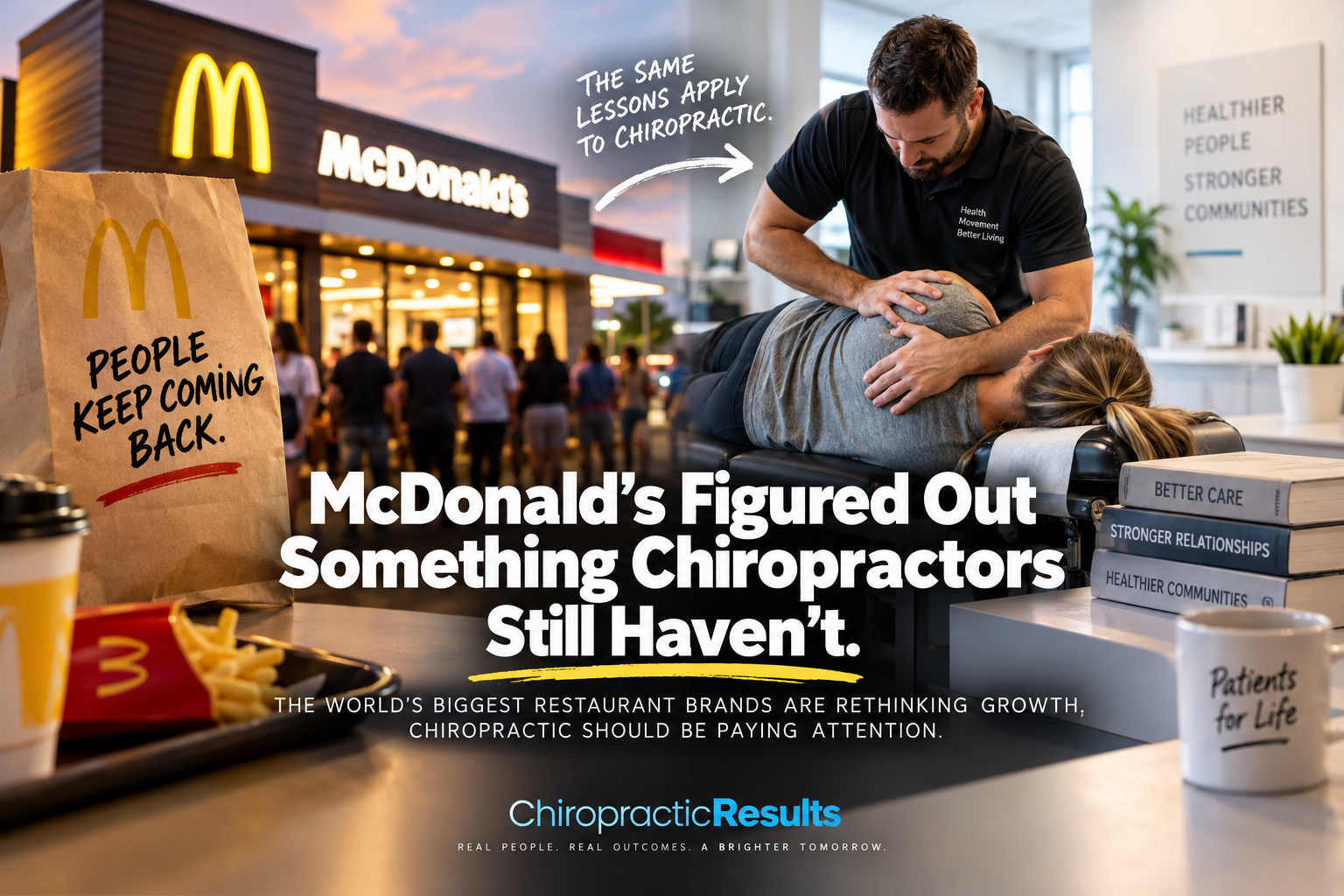
McDonald's Figured Out Something Chiropractors Still Haven't.
The world's biggest restaurant brands are rethinking growth. Chiropractic should be paying attention.
By ChiropracticResults | October 2026
McDonald's spent more than half a billion dollars on advertising in the United States last year.
Burger King spent another $409 million.
Wendy's? $319 million.
Chipotle? $267 million.
Subway? More than $207 million.
These are companies with enormous marketing departments, sophisticated customer databases, decades of consumer research, and access to some of the best advertising minds money can buy.
And do you know what many of them are suddenly worried about?
Getting people to come back.
Not just getting new customers.
Not producing another clever advertisement.
Not launching another promotional offer.
Getting the people who already know them, already trust them, and have already purchased from them to come back.
It's a fascinating shift.
And there's a lesson here that the chiropractic profession desperately needs to understand.
Because while the restaurant industry is rethinking the economics of customer loyalty, much of chiropractic is still operating under a remarkably simple business philosophy:
More new patients will fix everything.
Production down? Need more new patients.
Collections flat? Need more new patients.
Doctor frustrated? Need more new patients.
Staff sitting around? Definitely need more new patients.
The marketing isn't working?
Fire the marketing company.
Hire a different one.
Run another $29 special.
And if that doesn't work, blame Facebook.
But what if chiropractic's biggest growth problem isn't that we aren't attracting enough people?
What if we're failing to maximize the relationships we've already earned?
The Restaurant Industry Is Having Its Own Reckoning
On October 6, 2026,Ad Agepublished an interesting examination of 12 marketing executives at America's largest restaurant brands.
The article, titled12 Restaurant Marketers Facing Intense Industry Pressure—What Each Must Do Next, explored the challenges facing everyone from McDonald's and Wendy's to Chipotle, Subway, Dunkin', Shake Shack, and Texas Roadhouse.
At first glance, it reads like another corporate marketing story.
New executives.
New advertising campaigns.
New customer acquisition strategies.
But look beyond the titles and the advertising budgets, and something more interesting emerges.
These companies are confronting a fundamental question:
What actually creates sustainable growth?
And increasingly, the answer isn't simply more advertising.
It's frequency.
Retention.
Experience.
Reputation.
Differentiation.
Relationships.
Sound familiar?
These aren't exclusively restaurant problems.
They're chiropractic problems.
And in some ways, chiropractic is facing an even more consequential version of the same challenge.
Because when somebody has a disappointing cheeseburger, they lose twelve bucks and an appetite.
When somebody has a disappointing healthcare experience, they may lose something far more important.
Their trust.
Let's examine what these companies are learning—and what chiropractors should be stealing.
Lesson One: McDonald's Is Learning to Love the Customers It Already Has
McDonald's has a problem most chiropractors would kill for.
Nearly everybody knows who they are.
They don't have to explain what a hamburger is.
They don't have to educate the public about french fries.
They don't have to spend advertising dollars convincing Americans that McDonald's exists.
Their challenge is different.
How do we get people who already eat at McDonald's to visit more frequently?
That's the question driving much of the company's current marketing strategy.
McDonald's is moving toward fewer, larger campaigns, more consistent brand messaging, and personalized offers designed to bring occasional and lapsed customers back.
Think about that.
One of the most recognized brands on the planet is looking at its existing customers and asking how to create more value from established relationships.
Now consider the average chiropractic office.
How many people have walked through its doors over the last ten years?
500?
2,000?
5,000?
Maybe 10,000?
How many of those patients haven't visited in the last six months?
How many haven't visited in a year?
How many received care, had a positive experience, and simply drifted away?
Not because they were angry.
Not because they hated the doctor.
Not because they swore off chiropractic forever.
Life happened.
They got busy.
They moved.
They changed jobs.
Their original complaint resolved.
Or they simply forgot about the practice.
And what has the average chiropractor done to maintain those relationships?
Sent an occasional birthday email?
A generic newsletter?
A Christmas card?
Maybe nothing.
Meanwhile, that same chiropractor is spending thousands of dollars every month introducing themselves to complete strangers.
They'll pay $150 to acquire a new patient while ignoring the patient who already knows where the office is located.
There's a certain absurdity to that.
Now, chiropractic isn't fast food. Patients should return when care is clinically appropriate, not because the office needs more visits.
But that makes the relationship even more valuable.
The chiropractor who educates patients, stays in touch, checks on progress, and remains available when new problems arise becomes a trusted resource.
The chiropractor who disappears after the last appointment becomes a distant memory.
The lesson from McDonald's isn't that chiropractors should convince everybody to come in more frequently.
It's thatthe relationship shouldn't end when the treatment plan does.
What chiropractors should do
Start treating your existing patient database like the valuable business asset it is.
Segment patients according to their history, needs, and relationship with the practice.
Develop appropriate follow-up systems.
Stay in touch with useful information.
Invite patients who may have new or recurring concerns to reconnect.
And stop assuming that the only path to growth begins with somebody who has never heard your name.
Because sometimes your next patient is somebody you already helped five years ago.
Lesson Two: Subway Discovered the Leaky Bucket
Subway's story might be the most important in the entire article.
For years, the brand pursued new customers while losing visits from its most frequent ones.
Its marketing executive described the business as having created aleaky bucket.
That's a beautifully simple description of a very expensive problem.
You pour more customers into the top.
They disappear through the bottom.
So you pour faster.
And faster.
And faster.
Eventually, you need an enormous advertising budget just to maintain the same level of business.
Chiropractic knows this movie.
We've been watching it for decades.
A practice generates 40 new patients.
Everyone celebrates.
The marketing company sends a report.
The doctor tells friends how well the campaign is performing.
But nobody asks what happened to the 40 patients who came in three months earlier.
How many completed clinically appropriate care?
How many understood their examination findings?
How many experienced meaningful improvement?
How many stopped because they felt better?
How many stopped because they were frustrated?
How many stopped because they didn't understand the recommendations?
And how many simply vanished without anybody noticing?
These distinctions matter.
A patient finishing appropriate care because their goals were achieved is a success—not a retention failure.
A patient disappearing because nobody explained the plan, followed up, or listened to their concerns is something entirely different.
Yet too many practices lump all departures into the same category.
And then ask the marketing company for more leads.
Here's the uncomfortable question.
What if your new patient problem is actually an existing patient experience problem?
You cannot purchase your way out of a broken patient journey forever.
At some point, the economics catch up.
What chiropractors should do
Stop measuring marketing success exclusively by the number of new patients acquired.
Track the entire journey.
From inquiry to appointment.
From appointment to examination.
From examination to informed treatment decisions.
From treatment to measurable progress.
From progress to appropriate completion, ongoing support, and future referrals.
Find out where people disengage.
And more importantly, find out why.
Because plugging the holes in your bucket might create more sustainable growth than buying a bigger bucket.
Lesson Three: Wendy's Is Proof That Marketing Cannot Save a Bad Experience
Wendy's is confronting declining customer traffic, questions about value, and inconsistent restaurant execution.
Its leadership has acknowledged that relying on endless promotions and collaborations isn't enough to maintain customer loyalty.
The actual restaurant experience has to support the marketing.
This seems obvious.
Until you look at chiropractic.
A doctor spends $5,000 on advertising.
The campaign promises compassionate care, personalized attention, and an exceptional patient experience.
Then the phone rings.
Nobody answers.
The patient fills out a website form.
Nobody responds for four hours.
Eventually, somebody from the office calls and sounds annoyed that the patient has questions.
The appointment gets scheduled.
The patient arrives.
Nobody greets them.
The paperwork is confusing.
The doctor is running 25 minutes behind.
And when the patient finally gets into the examination room, the experience feels rushed.
But don't worry.
The Facebook ad looked fantastic.
You cannot advertise your way into being a better business than you actually are.
You can certainly generate attention.
You might even generate appointments.
But advertising creates expectations.
And the patient experience either confirms those expectations or destroys them.
This is why a practice's operations are inseparable from its marketing.
Your phone system is marketing.
Your front desk is marketing.
Your scheduling process is marketing.
Your consultation is marketing.
Your follow-up is marketing.
Your clinical communication is marketing.
And the moment your advertising promises something your office cannot consistently deliver, you've created a credibility problem.
What chiropractors should do
Mystery-shop your own practice.
Seriously.
Have someone unfamiliar with your office call and attempt to schedule an appointment.
Submit a website inquiry.
Evaluate response times.
Review the confirmation messages.
Observe the patient arrival experience.
Assess whether the doctor explains things clearly.
Find out how consistently patients understand the next steps.
You may discover that the greatest opportunity to improve your marketing ROI has absolutely nothing to do with marketing.
It may be sitting behind your front desk.
Lesson Four: Chipotle Is Fighting the Discount Trap
Chipotle faces a challenge that should feel painfully familiar to chiropractors.
How do you justify your price when customers have cheaper alternatives?
Its marketing approach focuses on showing the quality of ingredients, preparation, and the human work behind the product.
Rather than relying exclusively on discounts, Chipotle wants people to understand what they're paying for.
Now let's talk about chiropractic.
How many advertisements have you seen that look something like this?
NEW PATIENT SPECIAL! $29!
Consultation!
Exam!
X-rays!
Limited time!
Book today!
There's nothing inherently wrong with an introductory offer, provided it's transparent, clinically appropriate, and compliant with applicable rules.
But there's a serious problem when price becomes your entire identity.
Because once you've trained consumers to choose you based on the lowest advertised number, you've made your practice incredibly easy to compare.
A $29 chiropractor looks suspiciously similar to a $39 chiropractor.
And both start to look expensive when somebody advertises $19.
Congratulations.
You've entered a race to the bottom.
Meanwhile, many chiropractors possess something far more valuable than a cheap first appointment.
Experience.
Clinical expertise.
Specialized training.
Thoughtful examination processes.
Condition-specific knowledge.
Documented patient outcomes.
The ability to recognize when chiropractic care is appropriate—and when referral to another provider is the better choice.
These things matter.
But the average patient has no idea how to evaluate them.
And whose responsibility is that?
Ours.
If patients don't understand the difference between two providers, price becomes one of the few differences they can easily recognize.
When you fail to demonstrate value, you force the patient to shop on price.
That's not the patient's fault.
That's a communication failure.
What chiropractors should do
Start showing your work.
Explain your examination process.
Introduce your clinical philosophy without burying people in jargon.
Explain how you assess progress.
Share meaningful, permission-based patient stories without promising that everyone will experience the same results.
Publish verified outcomes where possible.
Help patients understand not just what you do, but why it matters.
A patient who understands your value can make an informed decision.
A patient who sees nothing but a discount can only compare discounts.
Lesson Five: Burger King Is Turning Its Weaknesses Into a Strength
Burger King has been doing something unusual.
Admitting that some customers had legitimate complaints.
Rather than pretending the brand has always been perfect, its marketing acknowledges areas that needed improvement and invites customers to reconsider the experience.
That's an interesting strategy.
Especially in an industry like chiropractic, where nearly every practice website reads like a monument to its own excellence.
"We provide exceptional care."
"We treat patients like family."
"We're committed to your health and wellness."
"We're passionate about helping our community."
Wonderful.
So is everybody else.
Now imagine an office publishing something different.
"We surveyed our patients, and here's what we learned."
"Our wait times were longer than they should have been."
"Our scheduling process was frustrating."
"Some patients weren't clear about their treatment recommendations."
"Here's what we've changed."
That's compelling.
Why?
Because it's believable.
Real businesses have weaknesses.
Real businesses make mistakes.
Real businesses improve.
And patients understand that.
Trust doesn't require pretending you've never gotten anything wrong.
Trust requires demonstrating that you take the responsibility seriously.
What chiropractors should do
Ask patients what you could improve.
Not just what they love.
What frustrates them?
What creates confusion?
What nearly stopped them from scheduling?
What do they wish had been explained more clearly?
Then act on the answers.
And when meaningful improvements have been made, talk about them.
Not as a publicity stunt.
As proof that you're listening.
Lesson Six: Dunkin' Understands That You Need to Stay Memorable
Dunkin' has spent years building a distinctive brand identity that goes well beyond advertising coffee and doughnuts.
Its marketing includes recurring personalities, entertainment, cultural references, and stories that keep the company familiar.
The goal is not simply to generate an immediate transaction.
It's to remain relevant between transactions.
Chiropractic has a massive opportunity here.
Because the demand for healthcare is often episodic.
People may go months or years without needing your services.
Then something changes.
They develop a new problem.
An old complaint returns.
A family member needs care.
A friend asks for a recommendation.
And suddenly, the question becomes:
Who comes to mind?
Not necessarily who's running the cheapest special.
Not necessarily who has the prettiest website.
Who do they remember?
Who do they trust?
Who feels familiar?
The best chiropractic marketing doesn't simply wait until somebody needs care and then attempt to interrupt them with an advertisement.
It builds familiarity long before that moment arrives.
This is the concept of top-of-mind awareness.
And it matters enormously in a category where people may not purchase immediately.
What chiropractors should do
Develop a recognizable communication style.
Publish consistently helpful content.
Stay connected to your community.
Feature your people.
Share your philosophy.
Explain conditions and treatment options responsibly.
Create educational resources worth sharing.
And communicate with existing patients even when you have absolutely nothing to sell them.
Because when somebody finally needs a chiropractor,being remembered may be more valuable than being the cheapest.
Lesson Seven: Dutch Bros Knows That Personal Connection Is a Competitive Advantage
Dutch Bros has grown from a regional coffee brand into a much larger national operation.
One of its challenges is preserving the personal connection that made customers loyal in the first place.
It's a delicate balance.
Growth creates scale.
Scale creates systems.
Systems create consistency.
But poorly designed systems can also eliminate the very human qualities customers loved.
Chiropractors experience this constantly.
A practice starts small.
The doctor knows everyone.
Patients are greeted by name.
The office feels personal.
Then the practice grows.
Another doctor joins.
More staff are hired.
Schedules get busier.
Processes become standardized.
And suddenly, the patient who used to feel known starts to feel processed.
There's nothing wrong with systems.
In fact, systems are essential to delivering consistent, safe, high-quality care.
But the purpose of systems should be to preserve the experience—not eliminate the humanity.
A great system reminds the team about a patient's concerns.
It helps clinicians follow up on progress.
It supports clear communication.
It prevents people from falling through the cracks.
It makes the experience more personal, not less.
What chiropractors should do
Ask a simple question:
Does every patient feel like a person, or like an appointment slot?
Then examine your systems through that lens.
Remember important details.
Follow up on unresolved questions.
Communicate clearly.
Make patients feel recognized.
Because people may not remember every detail of your examination.
But they're very likely to remember whether they felt heard.
Lesson Eight: Texas Roadhouse Is Playing the Game Chiropractors Were Born to Win
This may be the most revealing story of them all.
Texas Roadhouse has built an enormously successful restaurant business while emphasizing local community relationships instead of traditional national television and print advertising.
Each location is encouraged to behave like a locally connected business.
Schools.
Community organizations.
Local employers.
Neighborhood relationships.
Its communications executive describes the approach as aground game versus an air game.
And here's where chiropractic should be paying especially close attention.
For years, chiropractors built successful practices through relationships.
The local football coach knew the chiropractor.
The gym owner knew the chiropractor.
The teachers knew the chiropractor.
The parents knew the chiropractor.
Patients referred friends.
Families referred families.
The chiropractor was a familiar, trusted part of the community.
Then digital marketing arrived.
And somewhere along the way, many offices convinced themselves that growth required an increasingly complicated collection of advertising platforms, funnels, software subscriptions, and agencies.
Now, digital marketing can be extraordinarily effective.
But it shouldn't replace the local relationship engine.
It should amplify it.
Texas Roadhouse is demonstrating that even at enormous scale, proximity and local relevance remain valuable.
What chiropractors should do
Get involved locally in ways that are meaningful and sustainable.
Build relationships with other healthcare providers.
Participate in community events.
Develop connections with schools, athletic organizations, and businesses.
Offer useful education.
Be present.
Be helpful.
Be somebody people know for the right reasons.
Because a chiropractic office doesn't need to become nationally famous.
It needs to become locally trusted.
And those are two very different marketing objectives.
The Bigger Problem: Chiropractic Has Confused Acquisition With Growth
Now zoom out.
Look at what these eight brands are collectively telling us.
McDonald's wants better customer frequency.
Subway wants to stop losing loyal customers.
Wendy's needs consistent execution.
Chipotle needs to communicate value.
Burger King needs to rebuild trust.
Dunkin' wants to remain memorable.
Dutch Bros wants to preserve personal connection.
Texas Roadhouse wants to dominate through community relationships.
Different companies.
Different challenges.
Different strategies.
But there's a common thread.
Growth is a function of the entire customer relationship, not merely the first transaction.
And that's precisely where chiropractic has a blind spot.
Much of our industry's marketing infrastructure has been designed around patient acquisition.
Lead generation.
Appointment setting.
New patient specials.
Cost per lead.
Cost per appointment.
Cost per new patient.
Those metrics matter.
But they're incomplete.
A practice with poor conversion can waste an exceptional lead-generation campaign.
A practice with poor clinical communication can undermine patient follow-through.
A practice with weak relationships can lose years of goodwill.
A practice with no compelling differentiation becomes vulnerable to price competition.
And a practice that cannot demonstrate its outcomes may struggle to earn trust in a crowded marketplace.
Yet the solution offered by much of the marketing industry remains remarkably consistent.
More traffic.
More leads.
More advertising.
We've built an industry of companies selling water to chiropractors who haven't fixed the holes in their buckets.
And because lead generation is relatively easy to measure, it's become the default definition of success.
But acquiring a patient is not the same thing as building a successful practice.
It's the beginning of the opportunity.
Not the end.
The Six Growth Engines Every Chiropractic Practice Needs
A healthy chiropractic business should have six interconnected growth engines.
1. Acquisition
Can the practice consistently attract people who are appropriate candidates for its services?
2. Conversion
Can the team turn inquiries into appointments and help patients make informed decisions about their care?
3. Retention and Care Completion
Can the practice deliver an experience that supports adherence to clinically appropriate recommendations, measurable progress, and successful completion of care?
4. Reactivation
Can the practice maintain meaningful relationships with former patients and reconnect when new needs arise?
5. Referrals
Does the patient experience inspire people to recommend the office to friends, family members, and others seeking care?
6. Reputation and Results
Can the practice demonstrate its clinical strengths, patient experience, and documented outcomes in ways that earn trust?
Most chiropractors invest heavily in the first.
Some invest in the second.
Far fewer have deliberate systems around all six.
That's where the opportunity exists.
Not simply in generating more demand.
But in building a practice capable of converting appropriate demand into exceptional experiences, meaningful results, and durable relationships.
And here's the important part.
These growth engines reinforce one another.
Better experiences create stronger referrals.
Better communication supports informed decisions and care completion.
Better documented outcomes improve differentiation.
Better differentiation can improve acquisition efficiency.
Better relationships can create more appropriate returning-patient opportunities.
It's a connected system.
And the stronger the system becomes, the less the practice needs to rely on constantly purchasing attention.
But There's a Ninth Lesson: The Brands That Win Make Their Value Visible
This is where the restaurant story becomes particularly relevant to the future of chiropractic.
Consider what Chipotle is doing.
It's showing how the food is prepared.
Not merely claiming the ingredients are better.
Consider Burger King.
It's demonstrating what has changed.
Not merely insisting the experience is wonderful.
Consider Texas Roadhouse.
Its actual restaurant environment—the food preparation, the atmosphere, and the local relationships—reinforces the brand's promise.
Each is finding ways to make an otherwise abstract promise more tangible.
And chiropractic has a serious problem in this area.
The value of chiropractic care is often difficult for prospective patients to evaluate before choosing a provider.
Consider a person searching for a chiropractor for headaches.
They may find 15 offices.
Every office has a website.
Nearly every office has positive reviews.
Many claim decades of experience.
Several mention headaches.
Some advertise specialized techniques.
And most promise excellent care.
How does the patient know who may be the best fit?
How do they evaluate the experience of one provider against another?
How do they identify the doctor who has relevant clinical experience with patients presenting with similar complaints?
Traditional marketing doesn't fully answer those questions.
Generic reviews don't necessarily answer them either.
A five-star review saying "great staff and friendly atmosphere" is valuable social proof.
But it doesn't tell a prospective patient much about a provider's experience with a particular condition.
That's whydocumented patient outcomes represent an important opportunity for chiropractic differentiation.
Not because one person's outcome guarantees another's.
It doesn't.
Not because chiropractic is appropriate for every condition.
It isn't.
And not because a case report replaces rigorous clinical evidence.
It doesn't.
But because responsibly documented patient experiences can provide useful, condition-specific context that generic advertising often lacks.
Imagine being able to see that a chiropractor has worked with patients presenting with complaints similar to yours.
Imagine understanding how the practice evaluates those cases.
Imagine seeing reported improvements, limitations, and clinical context rather than just a five-star rating.
Imagine finding a provider whose demonstrated experience is relevant to your needs.
That's a more informative way to make a healthcare decision.
And it creates an opportunity for practices that take the time to document the care they're providing.
The New Patient Journey Doesn't Always Start on Google
There's another dimension to this transformation.
The way patients discover providers is changing.
For years, chiropractic marketing largely revolved around traditional search engines.
Rank on Google.
Build reviews.
Optimize your website.
Buy advertisements.
Get found.
Those things still matter.
But consumers can now ask AI-powered search and recommendation tools more conversational questions.
"Who are the chiropractors in my area with experience helping patients with migraines?"
"What should I look for in a chiropractor who treats neck pain?"
"Which local providers have documented outcomes for patients with similar complaints?"
These questions are different from simply typing "chiropractor near me."
They're more contextual.
More specific.
Potentially more focused on evidence and fit.
AI systems may synthesize information from websites, directories, published resources, reviews, and other accessible sources when generating answers.
That doesn't mean an outcome published online will automatically lead to a recommendation.
AI systems are inconsistent, and their provider recommendations require scrutiny.
But it does mean that practices need to think beyond their own homepage.
Your digital reputation is no longer limited to what you say about yourself on your website.
It increasingly includes what independent, accessible sources say about you—and whether those sources give people and technology meaningful reasons to distinguish your practice.
For chiropractors, that raises an important strategic question:
Are you creating digital evidence of your expertise and patient experience?
Or are you simply publishing the same generic marketing language as every other office?
There's a difference between being visible and being credible.
And the future of provider discovery will likely reward practices that can achieve both.
The Chiropractor of the Future Won't Necessarily Be the Best Marketer
Let me clarify something.
Marketing will always matter.
The best clinical provider in the world cannot help a patient who never discovers that provider.
But the competitive advantage of the future may not belong to the practice that generates the most clicks.
It may belong to the practice that creates the strongest combination of:
Clinical excellence.
Patient experience.
Documented outcomes.
Community trust.
Operational consistency.
Digital discoverability.
Think about two hypothetical practices.
Practice A spends $8,000 per month on advertising.
It generates plenty of inquiries.
But its follow-up systems are inconsistent.
Its front desk struggles with scheduling.
Its patient communication is rushed.
It doesn't systematically document outcomes.
And its marketing message looks nearly identical to every competitor.
Practice B spends $4,000 per month.
It generates fewer initial inquiries.
But its patient experience is exceptional.
Its scheduling process is efficient.
Its team communicates clearly.
It follows up appropriately.
It earns referrals.
It documents meaningful outcomes.
And its reputation is reinforced by information patients can actually evaluate.
Which practice would you rather own?
Which practice is likely to withstand rising advertising costs?
Which practice has a more defensible position in its local market?
Which practice will be better prepared as the way patients discover healthcare providers evolves?
The answer isn't determined by the ad budget alone.
It's determined by the quality of the entire business.
And this is what the restaurant industry is beginning to recognize.
Marketing is no longer merely the department responsible for getting people in the door.
It must be connected to the experience that makes people want to choose the business in the first place.
Stop Measuring the Beginning of the Relationship as Though It's the End
Here's an experiment.
At your next team meeting, ask everyone to report how many new patients the office acquired last month.
Chances are, somebody knows.
Now ask these questions.
How many patient inquiries received a response within five minutes?
How many people who requested appointments actually scheduled?
How many scheduled patients arrived?
How many patients clearly understood their examination findings and options?
How many patients achieved meaningful improvement in their primary complaint?
How many completed their clinically appropriate care plan?
How many former patients reached out with a new concern?
How many patients referred somebody?
How many patient outcomes were documented?
How many people in your community could describe what genuinely distinguishes your office?
Suddenly, the room gets quieter.
Because most chiropractic practices have become very good at measuring the beginning of the patient relationship.
And remarkably inconsistent at measuring everything that happens afterward.
This is not an argument against new patient marketing.
Far from it.
A healthy practice needs a consistent flow of appropriate new patients.
It's an argument againstmistaking one component of growth for the entire growth strategy.
A lead is an opportunity.
An appointment is an opportunity.
A new patient is an opportunity.
None of them, by themselves, proves the practice has delivered meaningful value.
The real test is what happens next.
Five Things Every Chiropractor Should Do in the Next 30 Days
You don't need McDonald's advertising budget to apply these lessons.
You don't need a marketing department.
You don't need a multimillion-dollar CRM.
You need to pay attention to the parts of your business that already exist.
First: Audit your inactive patient database.
Find out how many people haven't visited in six months, twelve months, or longer.
Determine which patients may benefit from appropriate follow-up.
Develop relevant, personalized outreach rather than blasting everyone with the same promotion.
Second: Find the leaks.
Examine every transition in the patient journey.
Inquiry to appointment.
Appointment to arrival.
Examination to informed care decision.
Treatment to documented progress.
Progress to appropriate completion.
Don't automatically treat a discharge as a loss.
Distinguish successful completion from preventable disengagement.
Third: Mystery-shop your own practice.
Have somebody experience your office as a prospective patient.
Measure response times, communication, scheduling friction, and clarity.
Fix the obvious problems before spending more money magnifying them.
Fourth: Make your value visible.
Document your expertise.
Explain your processes.
Show your team.
Share patient experiences responsibly and with permission.
Measure outcomes using appropriate methods.
Give prospective patients meaningful reasons to consider your practice beyond a discounted examination.
Fifth: Rebuild your local relationship engine.
Identify the organizations, professionals, patients, and community relationships that matter in your market.
Don't simply ask them for referrals.
Become useful to them.
Become familiar.
Become trusted.
And become the kind of practice people are comfortable recommending.
The Final Lesson: Stop Renting Growth. Start Building It.
There's a fundamental difference between renting attention and building a business people want to return to.
Advertising rents attention.
You pay.
People see your message.
You stop paying.
The attention usually stops.
But a strong reputation continues working.
A remarkable patient experience creates memories.
A meaningful clinical outcome creates value.
A trusted relationship creates future opportunities.
A patient who enthusiastically recommends you introduces someone new to your practice.
A growing body of responsibly documented outcomes helps tell a more substantial story about the care you provide.
Those are assets.
They're not substitutes for clinical quality or marketing.
They're the things that make marketing more effective.
And they're harder for competitors to copy.
A competitor can duplicate your introductory offer tomorrow.
They can hire your advertising agency.
They can build a prettier website.
They can copy your Facebook campaign.
They can even undercut your prices.
But they cannot instantly reproduce ten years of earned community trust.
They cannot manufacture your team's relationships.
They cannot inherit your patients' authentic experiences.
And they cannot credibly claim clinical outcomes they haven't achieved and documented.
The strongest chiropractic practices won't merely attract attention. They'll accumulate trust.
That's the distinction.
And it's why this seemingly ordinary story about restaurant marketing matters so much to our profession.
McDonald's is rediscovering existing customers.
Subway is confronting its leaky bucket.
Wendy's is reconnecting marketing with operational execution.
Chipotle is demonstrating value rather than simply discounting.
Burger King is acknowledging shortcomings.
Dunkin' is building memory.
Dutch Bros is protecting personal connection.
Texas Roadhouse is strengthening local relationships.
Eight companies.
Eight different challenges.
One common lesson.
The most sustainable growth doesn't come from constantly finding more strangers. It comes from creating an experience, a reputation, and a relationship worth choosing.
The restaurant industry is spending billions of dollars learning that lesson.
Chiropractors have an opportunity to learn it for considerably less.
But first, we have to stop believing that another 30 new patients will magically fix everything.
Because if the experience is broken, if the systems are broken, if the value isn't clear, and if the outcomes aren't being measured, another advertising campaign may only make those weaknesses more expensive.
The future of chiropractic won't be won by the office that shouts the loudest.
It will be won by practices that consistently deliver appropriate care, demonstrate meaningful results, build enduring trust, and make their value discoverable.
Stop competing to be the cheapest chiropractor in town.
Start doing the work to become one of the most trusted.
And make sure people have a way to understand why.
The ChiropracticResults Perspective
At ChiropracticResults, we believe the next evolution of chiropractic marketing is the shift from simply making claims to making credible, documented outcomes easier to discover.
Visibility matters. But visibility without evidence is incomplete.
Our mission is to help make real-world patient outcomes more accessible so people can make better-informed decisions when choosing chiropractic care.
Because the profession deserves to be evaluated on more than advertising budgets, generic promises, and introductory specials.
The results should be part of the conversation.
Inspired by Jon Springer's October 6, 2026, Ad Age article, “12 Restaurant Marketers Facing Intense Industry Pressure—What Each Must Do Next.” Restaurant spending and company strategy details are drawn from that reporting. The chiropractic applications and recommendations are editorial analysis, not claims made by the featured restaurant brands.