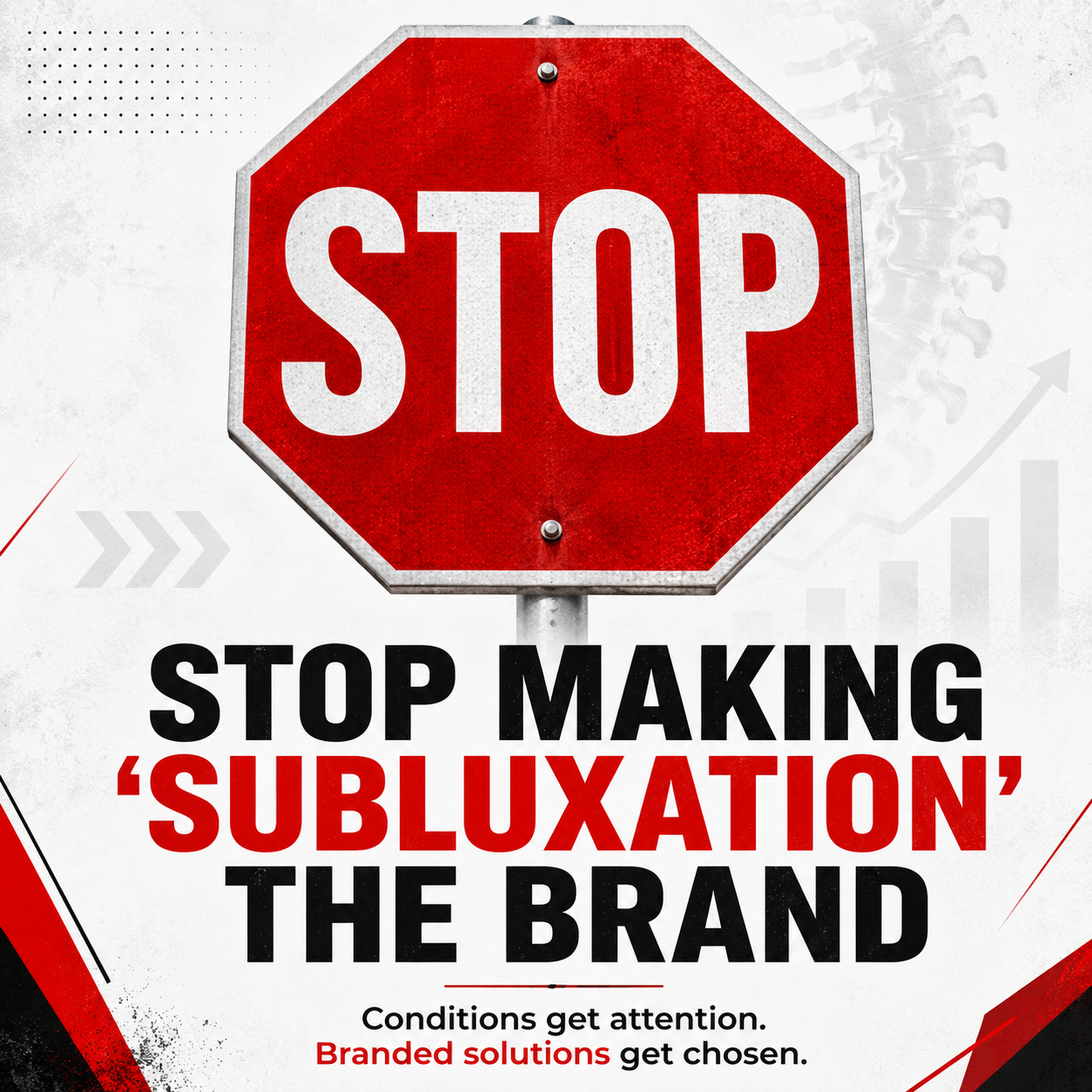
Stop Trying to Make “Subluxation” the Brand
I friend shared a post with me earlier today.
“Chiropractors think people have a hard time understanding the word subluxation, but in less than two years, 90% of the population learned the word tirzepatide.”
At first glance, it sounds like a great point.
People can learn complicated words when the words become important enough.
Except there are two problems.
First, most people do not know the word tirzepatide.
They know:
Ozempic. Wegovy. Mounjaro.
Those are the heavily marketed brand names.
Most people still couldn’t tell you what tirzepatide is—and Ozempic isn’t even tirzepatide.
Second—and this is the more important mistake—tirzepatide is not the problem.
It is the solution.
Nobody wakes up in the morning and says:
“I think I have tirzepatide.”
They have diabetes.
They are struggling with their weight.
They cannot control their appetite.
They are worried about their blood sugar.
Those are the problems they recognize.
Then a company gives them a branded solution.
That is the actual marketing lesson for chiropractors.
Subluxation Is Not Your Ozempic
Subluxation is supposed to describe the problem a chiropractor identifies and corrects.
It is not the branded solution.
Yet chiropractors often attempt to market the word subluxation as if making the public understand it is the ultimate victory.
We create videos about subluxation.
We make brochures explaining subluxation.
We build websites around subluxation.
We lecture patients about subluxation.
Then we become frustrated when the public still searches for:
“Chiropractor for sciatica.”
“Chiropractor for migraines.”
“Chiropractor for neck pain.”
“Chiropractor near me for pregnancy pain.”
Maybe the public is not failing to understand chiropractic.
Maybe chiropractors are failing to understand marketing.
Before anyone gets their panties twisted and begins waving a BJ Palmer dildo in my direction, this is not an argument about whether subluxation exists.
It is not a philosophical debate.
It is a branding and communication conversation.
You can believe in subluxation.
You can assess subluxation.
You can correct subluxation.
But that does not automatically make subluxation the best word to lead with when trying to earn the attention of someone who does not yet understand chiropractic.
Great marketing does not demand that customers learn the company’s internal vocabulary before they are allowed to care.
It begins with something the customer already recognizes.
Conditions Matter Because Conditions Are the Doorway
There is a strain of chiropractic marketing that treats mentioning conditions like some kind of philosophical betrayal.
“The condition should not be the focus.”
“Chiropractic is about function, not symptoms.”
“We do not treat conditions.”
Fine.
But patients still experience conditions.
They experience headaches.
They experience sciatica.
They experience neck pain.
They experience numbness, poor sleep, limited movement, dizziness, back pain, and discomfort during pregnancy.
Those are not marketing inventions.
Those are the problems happening in their lives.
Conditions matter because conditions are frequently how people become aware that they need help.
They are the doorway.
That does not mean the condition must become the entirety of your clinical identity.
It does not mean making promises you cannot support.
It does not mean claiming every person with a particular diagnosis will get the same result.
It means meeting people where they are.
The patient usually does not begin with:
“I wonder whether I have neurological dysfunction associated with altered vertebral mechanics.”
They begin with:
“My neck hurts, and I cannot turn my head.”
Your job is to connect the problem they recognize to the deeper explanation, clinical findings, and solution you provide.
Ignoring the condition does not make your marketing more principled.
Sometimes it only makes it less relevant.
Big Pharma Does Not Begin With the Mechanism
Imagine a pharmaceutical commercial opening with:
“Do you suffer from impaired incretin signaling and insufficient glucose-dependent insulin secretion?”
Most people would have no idea what it meant.
Instead, the commercial begins inside the customer’s existing reality.
Struggling to lose weight?
Worried about your blood sugar?
Still feeling hungry after eating?
Then the company introduces its branded solution.
Only after earning attention does it explain how the product works.
Chiropractic marketing frequently does the reverse.
We lead with the mechanism.
Subluxation.
Nerve interference.
Spinal dysfunction.
Vertebral misalignment.
Then we eventually get around to explaining why any of it matters to the person reading the ad.
That is backward.
The marketing sequence should usually be:
Recognized problem → desired outcome → branded solution → deeper explanation.
Not:
Professional terminology → philosophical lecture → confused patient → no appointment.
Branded Techniques Turn an Invisible Service Into a Product
This is also why branded techniques, systems, and processes matter.
Most chiropractic care is difficult for the public to compare.
To a patient, one adjustment can look a lot like another adjustment.
One chiropractor’s website can sound nearly identical to every other chiropractor’s website.
“We treat the whole person.”
“We get to the root cause.”
“We provide personalized care.”
“We help your body heal naturally.”
Those phrases have become so common that they communicate almost nothing.
A branded technique or process creates distinction.
It turns an abstract service into something a patient can name, remember, repeat, and refer.
Instead of:
“We do a thorough examination.”
You have:
The Results Mapping Exam™
Instead of:
“We create an individualized care plan.”
You have:
The 90-Day Function Restoration Plan™
Instead of:
“We adjust pregnant women.”
You have:
The Pregnancy Comfort Protocol™
Instead of:
“We help people with headaches.”
You have:
The Migraine Pattern Assessment™
The name alone does not create value.
Slapping a trademark symbol on ordinary care does not magically make it special.
The branded process must represent something real:
A specific assessment.
A repeatable method.
A clear patient experience.
Defined checkpoints.
Measurable outcomes.
A meaningful difference in how care is delivered.
But once those pieces exist, branding helps patients understand the difference.
It gives the solution a container.
It also gives patients language they can use when talking to other people.
“I went through their Results Mapping Exam.”
“They put me on the Pregnancy Comfort Protocol.”
“They use a specific method for runners with hip and back pain.”
That is easier to remember and refer than:
“My chiropractor checks for subluxations.”
The Solution Needs a Name
A condition captures attention because the patient recognizes the problem.
A branded technique creates interest because it makes the solution feel understandable and distinct.
Verified outcomes create trust because they show that the solution has produced meaningful results for people with similar problems.
That is the complete marketing chain:
Condition → branded solution → verified result.
This is where ChiropracticResults fits.
A chiropractor should not have to claim:
“We are the best.”
They should be able to show:
“We have documented results with people experiencing this problem.”
The condition makes the clinic discoverable.
The branded process makes the clinic differentiated.
The outcome makes the clinic believable.
That is far more powerful than trying to convince the entire population to become emotionally invested in the word subluxation.
The Patient Does Not Need to Love Your Diagnosis
Patients rarely fall in love with the technical name of their problem.
They fall in love with a solution that makes sense.
They want to know:
Do you understand what I am dealing with?
Have you helped people like me?
What makes your approach different?
How will we measure whether it is working?
What happens when I begin care?
Those are branding questions.
Those are marketing questions.
Those are trust questions.
You can introduce subluxation as part of the explanation.
You can educate patients about the nervous system.
You can teach the philosophy behind your care.
But education works better after relevance has been established.
First, show people that you understand their world.
Then give your solution a memorable name.
Then support it with real results.
The objective is not to make subluxation famous.
The objective is to make your clinic’s solution clear, differentiated, credible, and easy to choose.
Because the greatest marketing achievement is not getting the public to memorize your terminology.
It is getting the right patient to say:
“That sounds like it was built for someone exactly like me.”