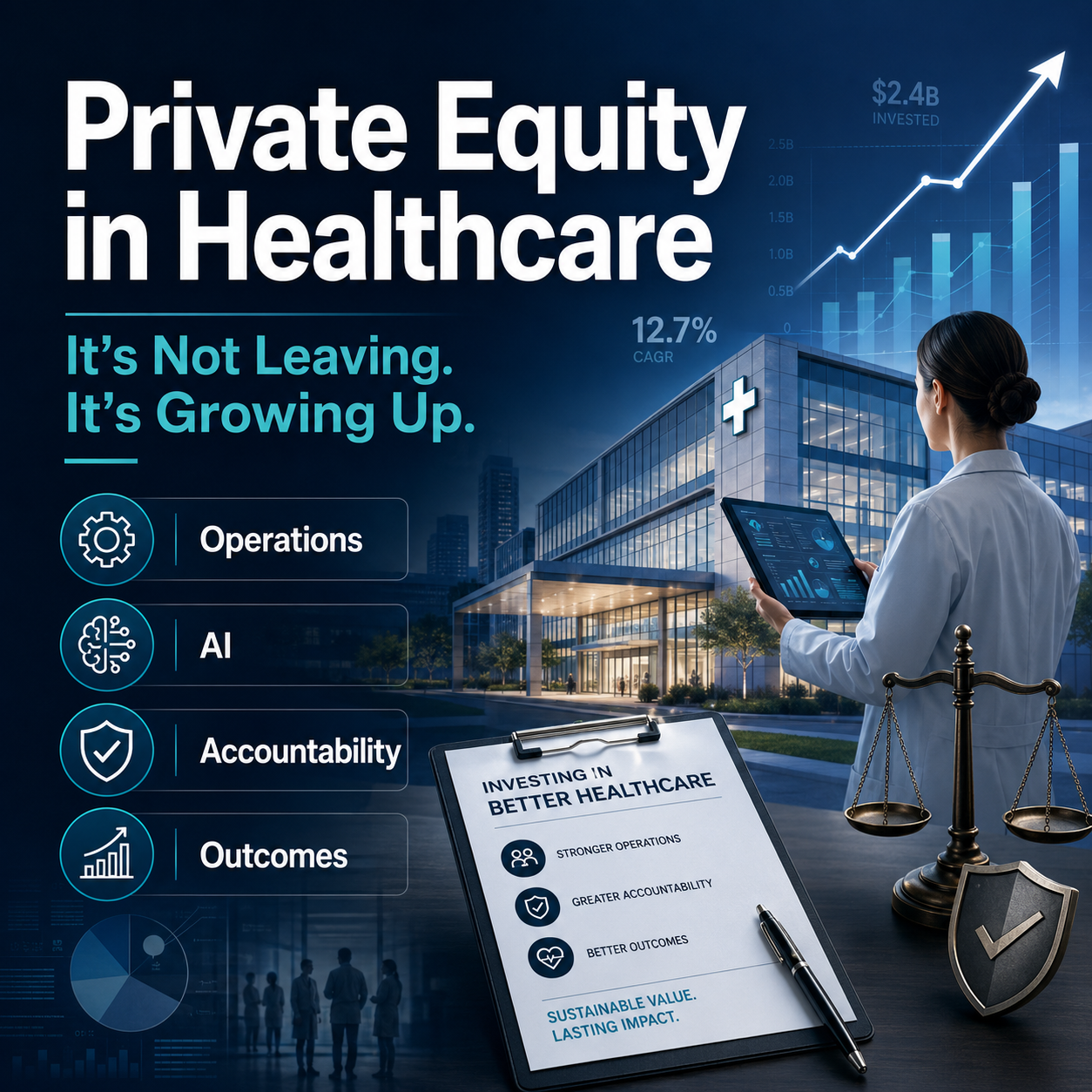
The biggest healthcare private-equity trends right now
**## The biggest healthcare private-equity trends right now
As of August 2026, healthcare PE is active again—but investors are more selective, more operationally involved, and much more cautious about regulatory and reimbursement risk.
1. Deal activity is recovering, but mediocre businesses are getting punished
Healthcare M&A has regained momentum, with total healthcare transaction value approaching$284 billion in 2026, nearly matching all of 2025 already. However, healthcare-services PE deal count fell16% year over year in Q1, while deal value declined 23.3%. Translation: capital is available, but it is concentrating in fewer, higher-quality assets.
The market is increasingly split:
- Strong platforms with differentiated outcomes, durable reimbursement and good management still receive premium interest.
- Average “buy a bunch of clinics and cut costs” platforms face tougher financing, lower multiples and longer holding periods.
- Add-on acquisitions remain attractive because they can be purchased more cheaply than major platforms.
2. The old roll-up playbook is becoming an operations playbook
PE firms can no longer depend primarily on buying smaller practices, combining them and selling the larger group at a higher multiple.
They are now expected to create measurable operational improvements through:
- Centralized revenue-cycle management
- Better scheduling and patient conversion
- Procurement savings
- Staffing efficiency
- Standardized clinical and administrative workflows
- AI-enabled documentation, billing and patient communication
- Improved referral and payer contracting infrastructure
KPMG reports particularly strong investor interest in healthcare technology supporting clinical documentation, diagnostics, revenue cycle, staffing productivity and patient engagement.
The new thesis:buy healthcare businesses where technology and management can expand EBITDA without obviously compromising care.
3. AI is becoming part of the investment thesis—not merely a software expense
Investors are increasingly asking whether a target can use AI to:
- Reduce administrative labor
- Improve collections
- automate charting and coding
- Predict cancellations and patient leakage
- Improve call-center performance
- Identify referral patterns
- Measure outcomes across locations
Healthcare capital is increasingly flowing toward scalable platforms, resilient business models and AI-supported services.
The important distinction is that buyers are becoming skeptical of companies that simply say, “We use AI.” They want evidence that it improves margins, clinician capacity, collections or patient outcomes.
4. Regulatory risk is moving from the footnotes to the center of every deal
State-level scrutiny is accelerating. As of early 2026, at least79 bills across 25 statesaddressed healthcare PE transactions or investor-backed ownership. Policymakers are examining:
- Corporate practice of medicine
- MSO control over clinical entities
- Transaction-notification requirements
- Noncompetes and physician restrictions
- Sale-leaseback structures
- Debt placed on clinical businesses
- Staffing reductions
- Market concentration
- The independence of clinical decision-making
New York, for example, has considered expanding its corporate-practice restrictions to prevent nonphysician MSOs or PE firms from exercising majority voting or board control over professional medical corporations.
This does not mean healthcare PE is stopping. It means investors will increasingly prefer structures that can demonstrate:
- Genuine physician governance
- Clear separation of clinical and management decisions
- Transparent fee arrangements
- Defensible quality metrics
- Community and patient benefits
5. Physician consolidation continues, but penetration varies dramatically
About6.5% of physicians worked in PE-owned practices in 2024, up from 4.5% in 2022. That sounds relatively small, but PE accounted for an estimated65% of physicians whose practices were acquired by any type of entity between 2019 and 2023.
Penetration is highly uneven. The GAO cited research showing approximately:
- 1.5% of primary-care physicians were PE-backed in 2022.
- 29% of retina specialists were PE-backed.
- 11% of dermatologists were in PE-backed practices by 2021.
- 6% of radiologists were in PE-backed practices by 2021.
This means the next wave is less likely to be indiscriminate. Buyers are searching forfragmented specialties where enough independent operators remain to create a platform.
6. Hot sectors are shifting toward resilient, fragmented and outpatient care
The most attractive areas currently include:
- Behavioral health
- Autism and developmental services
- Home-based care
- Elder care
- Infusion and specialty pharmacy
- Revenue-cycle management
- Healthcare IT
- Post-acute services
- Value-based-care infrastructure
- Select physician specialties with procedure or ancillary revenue
Behavioral health, home-based care and revenue-cycle platforms continue to attract PE interest, although reimbursement uncertainty remains a meaningful risk—especially in behavioral health.
Elder care was described by PitchBook as a relative bright spot during an otherwise difficult first quarter for healthcare services.
7. Buyers want recurring, diversified revenue—not one reimbursement trick
Practices heavily dependent on one payer, one procedure, one lead source or one charismatic founder are becoming harder to finance.
The strongest assets tend to have:
- Diversified payers and revenue sources
- A repeatable patient-acquisition system
- Multiple providers rather than one rainmaker
- Strong retention and collections
- Low provider turnover
- Documented compliance
- Consistent location-level reporting
- Defensible clinical outcomes
- Ancillary revenue that is clinically appropriate
- A clear path to additional locations or acquisitions
High valuations, uncertainty around future target performance and competition for a limited number of exceptional assets remain major barriers to 2026 dealmaking.
8. Outcomes and quality evidence are becoming financially valuable
The political argument against healthcare PE frequently centers on the possibility of higher prices, reduced staffing or declining access. The GAO found some evidence connecting physician consolidation involving PE with higher privately insured prices, while noting that evidence on access, spending and quality remains incomplete.
That makes outcome documentation increasingly important—not just clinically, but transactionally.
A platform that can prove:
- Patient improvement
- Safety
- Appropriate utilization
- Satisfaction
- Reduced readmissions or unnecessary escalation
- Access improvements
- Provider retention
has a stronger defense against regulators, payers, critics and future buyers.
What this means for chiropractic
Chiropractic is fragmented, recurring-revenue-friendly and operationally improvable, which makes it theoretically attractive. But a pure “buy clinics and sell care plans harder” roll-up would face serious reputational and regulatory vulnerability.
A more compelling chiropractic PE thesis would be:
Acquire or partner with strong clinics, preserve doctor ownership and clinical authority, centralize nonclinical operations, improve patient acquisition and retention, and build the industry’s first credible outcomes-data layer.
The attractive assets would not simply be the clinics with the most revenue. They would be clinics with:
- Documented patient outcomes
- Strong reputation and local authority
- Low doctor dependence
- Clean financial reporting
- Repeatable new-patient conversion
- Appropriate care-plan utilization
- Multiple providers
- Expansion capacity
- Ethical risk-reversal mechanisms
- Data that demonstrates clinical value
That is also where ChiropracticResults could become strategically important. PE-backed groups need an independent-looking evidence, reputation and outcomes infrastructure. The clinics already building verified outcome histories may become considerably more valuable than clinics that merely have good revenue.
My blunt read:PE is not leaving healthcare. It is being forced to grow up.The next winners will look less like financial engineers and more like sophisticated healthcare operating companies**