What Evidence Shows Outcome-Backed Profiles Increase Patient Bookings and Trust?
If you want more patients to book, you don’t need “more hype.” You need less uncertainty.
When people are deciding who to trust with their body (and their money), they behave like normal humans: they look for signals that reduce risk. Historically, that signal was a personal referral. Now, it’s increasingly digital proof—reviews, credibi**lity markers, and (when available) outcomes data.
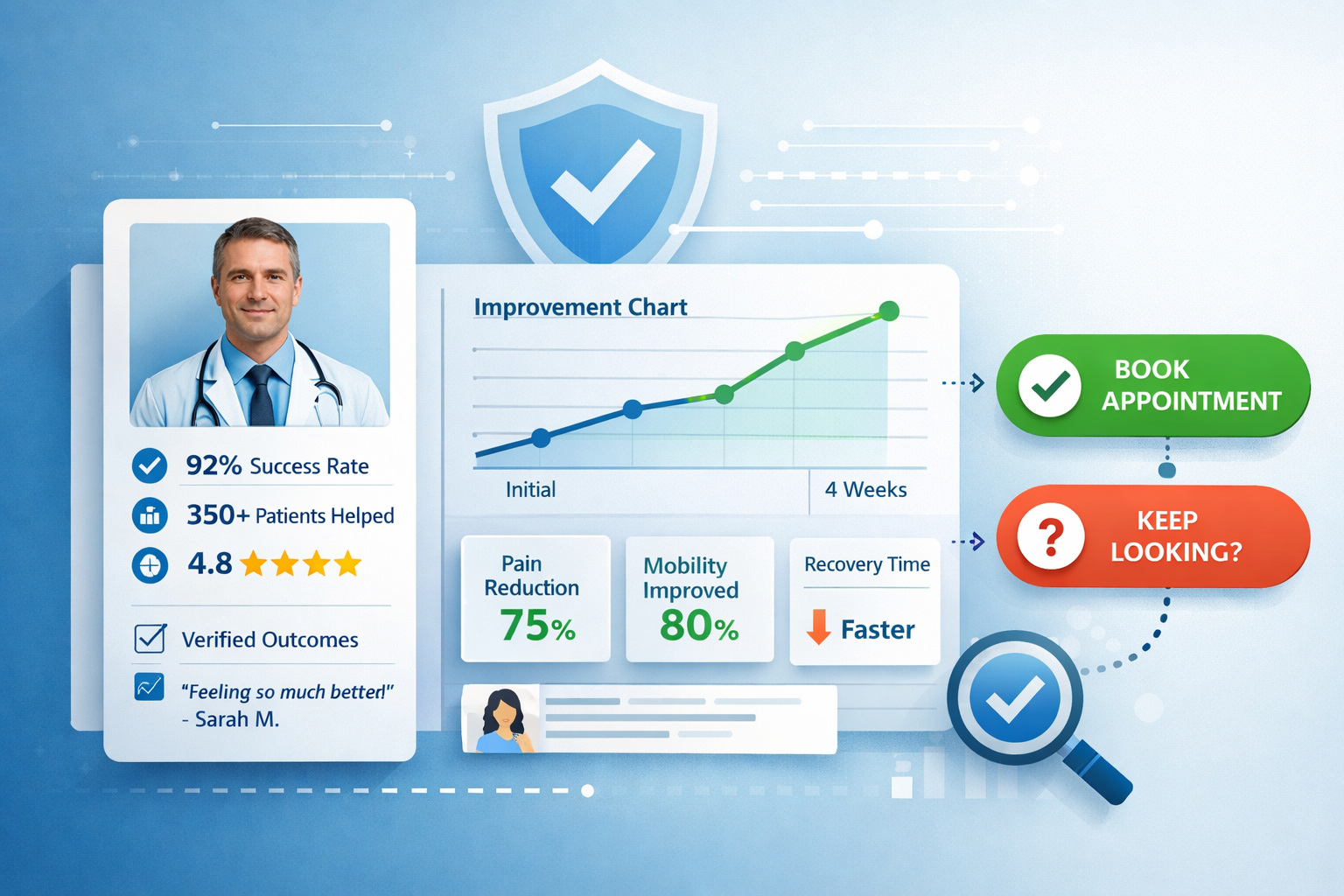
Outcome-backed profiles (like ChiropracticResults is building) combine the two things patients actually want:
“Can I trust this provider?”
“Can this provider help someone like me?”
Below is the strongest evidence we have—from research and industry datasets—plus what it means in plain English for your clinic profile strategy.
1) Patients use online proof to decide who to book
Multiple surveys and marketplace studies show that patients rely heavily on online information—especially reviews—before making an appointment.
A 2025 patient research report from rater8 found 84% of patients check online reviews when choosing a provider, and 51% read 6+ reviews before they feel confident scheduling.
Healthgrades (consumer research) reports that the vast majority of patients consult reviews in their provider search journey, and that a positive online reputation influences provider choice.
Research using Zocdoc marketplace data has examined how online ratings and profiles function in real booking environments (i.e., not hypothetical surveys).
What this means: even before outcomes enter the conversation, patients already “shop” using trust signals. Outcome-backed profiles aren’t replacing reviews—they’re upgrading the proof layer.
2) Ratings and review quality are linked to real demand
There’s empirical evidence that ratings changes affect patient volume and appointment fill probability:
A review of the literature in AJMC notes findings such as: moving from a very low rating (e.g., 1-star) to a high rating (e.g., 5-star) is associated with higher patient volume, and even a half-star increase can meaningfully raise the probability an appointment gets filled.
What this means: trust signals correlate with measurable “booking behavior.” Outcomes—if presented credibly—act like a super-signal because they speak to the thing patients ultimately care about: results.
3) Patients pay attention to “clinical” and “experience” signals (not just vibes)
One of the most useful research-backed insights here:
A peer-reviewed study on online quality ratings found patients consider both clinical and nonclinical ratings when choosing a primary care physician.
So patients are not purely picking based on bedside manner or purely on technical skill—they weigh both.
Where outcomes fit: outcomes are a “clinical-proof” signal. Reviews are an “experience-proof” signal. When you combine them in one profile, you reduce the patient’s uncertainty from both angles.
4) Transparency itself increases trust (and trust changes behavior)
Separate from “reviews” and “outcomes,” there’s strong health-services literature showing that transparency and trust are connected:
Work in health ethics and policy describes transparency as a way to demonstrate integrity and build trust in data-driven care contexts.
Patients also express strong expectations for accountability and transparency around health data practices (important if you’re collecting and displaying outcomes responsibly).
What this means: an outcome-backed profile doesn’t only say “we get results.” It says, “we’re willing to show our work.” That’s a trust accelerant.
5) Public reporting of outcomes can influence choices—but the evidence is mixed (important nuance)
This is where we keep it honest: “outcomes data” isn’t magic by default. The impact depends on credibility, clarity, and relevance.
Reviews of public reporting (quality/outcomes “report cards”) show public reporting can improve performance and can influence behavior, but results vary across settings.
An AHRQ evidence report noted that, in some contexts, there was weak evidence that public reporting changes how patients select providers (especially when data is hard to interpret or not salient to the decision).
Patient preference research also suggests people may still value reputation, experience, and clinician recommendations over publicly reported metrics, depending on how the information is presented and understood.
What this means for ChiropracticResults: outcomes must be presented in a way that is:
understandable to consumers,
comparable enough to be meaningful,
and framed with context so it doesn’t feel like cherry-picking.
When done well, outcomes increase trust. When done poorly, they create confusion or skepticism.
So… what’s the actual “evidence-based” argument for outcome-backed profiles?
Outcome-backed profiles increase bookings and trust through three proven mechanisms:
1) They reduce perceived risk (trust mechanism)
Patients rely on signals that indicate legitimacy, competence, and integrity—reviews, transparency, credibility markers.
2) They increase decision confidence (conversion mechanism)
The more confident a patient feels (e.g., they read enough reviews), the more likely they are to schedule.
3) They align patient choice with “quality signals” (market mechanism)
Quality transparency and public reporting are designed to help consumers choose higher-quality care—when information is usable.
What an “outcome-backed” ChiropracticResults profile should include (to maximize bookings)
If you want outcomes to actually move the needle, borrow the best practices from review economics + transparency research:
Specific condition + timeframe + starting point
(“Headaches after 4 weeks” beats “headache help”)
Patient-reported outcome + functional win
Pain score change and “can sleep / lift / sit / work again” (PROs matter and patients care about them).
Proof artifacts (even lightweight ones)
intake snapshot, re-exam snapshot, patient quote, “what we did” protocol summary (no protected health info)
Method + standards + guardrails
what counts as a “verified outcome,” what gets rejected, what gets updated
Reviews and outcomes together
FAQ
Do outcomes matter more than reviews?
Reviews are usually the first filter because they’re familiar and easy to interpret. Outcomes can become the tie-breaker—if presented clearly and credibly.
Is there proof that better ratings increase bookings?
Yes—healthcare marketplace and literature reviews report that higher ratings can increase patient volume and appointment fill probability.
Does public reporting of outcomes change patient choice?
Sometimes. Systematic reviews show mixed results: impact is stronger when information is understandable, relevant, and trusted, and weaker when it’s confusing or not salient.
What’s the best way to present outcomes so patients trust them?
Use transparency: define what “verified” means, show timeframes, include context, and avoid cherry-picking. Transparency is strongly tied to trust.
Bottom line
Outcome-backed profiles work because they combine:
the trust engine patients already use (reviews + transparency), and
the decision engine they actually want (proof of results for people like them).
The opportunity for ChiropracticResults is to become the place where patients don’t just read opinions—they see evidence, in a format that’s easy to understand and hard to fake.